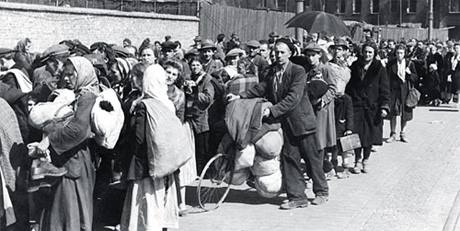
I was 13 when the army invaded. Those who were around the last time it happened had told us about the atrocities they committed, and we were really scared. So, along with many others, my family and I packed a few belongings and fled.
My mother took our little dog along and he became our air strike warning. He would hear - or feel, I'm not sure - the planes before we did, so whenever he started whining, we took cover, often in ditches. My mother would cover us with a big red blanket. I don't know what kind of protection she thought that was! The noise from the planes was terrifying, the bombs were even more so.
We crossed the border, but we were not welcome. Villages had signs saying there was no water for us. We were exhausted. We had to sleep in ditches.
At one point we met another family who came from the same village as we did. One of the boys, who would become my husband once we grew up, wrote me a card. I still have it. But we lost each other again that time and only saw each other again when we came back to our village.
I understand those people fleeing war. We did the same thing.
- my grandmother
When the German army invaded Belgium in 1940, 2 millions Belgians, Dutch and Luxemburgers fled and became refugees in France.
So what is it like to work at a Red Cross centre for asylum seekers? Well, it is many things.
It's challenging.
We house about 500 people from over 10 different nationalities, with a broad range of culture, education and background. Most are Muslims, some are Christians, a few are atheists. Some come from big cities, others from remote villages. We have single men, families (up to 10 children), single women, couples (including a few gay couples) and a few unaccompanied minors (teenagers). There's bound to be tensions and disagreements, and if you don't manage to calm things down and find a compromise everybody agrees on, you may very well have a fight on your hands.
Because let's face it: this is a human population like any other. Some people are hard-working and offer to help out straight away, others are lazy. Some are kind and meek, others are angry and aggressive. They all have qualities and faults like the rest of us. Being asylum seekers doesn't make them angels (and equally, it doesn't make them demons either!). And all of them are under a huge amount of anxiety and stress, having gone through a rough journey (not to speak about the horrors of war and persecution), being housed in far-from-ideal conditions in a strange country, and living in complete uncertainty about their own future, as they don't know whether and when their asylum request will be granted.
Moreover, the centre is actually an old, de-commissioned hospital. Not only was it not in very good conditions to begin with, but it was never designed to accomodate 500 people. We get daily complaints about leaks, heating or water failures, or broken electrics. To top it all, we are in an rural area. The nearest village is 30 minutes away on foot, and the nearest town is 30 minutes away by bus (and busses don't run at the weekend). Residents feel isolated.
Then there is the language barrier. The majority of them only speak very, very basic English (or none at all), so communication can be a huge issue. When a mother comes to you in a panic, speaking quickly in Farsi while holding her child, and there is no one near who could translate what she is so urgently trying to tell you, it's intensely frustrating and stressful, because you know she needs you, but you can't help her until you've found someone who speaks Farsi AND English.
It's chaotic.
The centre only opened on October 1st, and a lot of repairs and refurbishment had to be done. We've had days when we knew a coach of 50 people would arrive an hour later, and workmen were still putting in showers and kitchens in the block where we were supposed to house them. The beds that were initially ordered turned out to be a disaster, as most of them broke, and we had to order new ones. Some rooms don't have a lock yet, resulting in children pillaging a room where we had stocked donated toys - I wanted to cry when I saw the state of the room afterwards. Fortunately, parents came to help us tidy up. In any case, we're often running around like headless chickens because there is so much to do.
It's heartbreaking.
One man broke down in tears in front of me after being transferred to our centre. After enduring a dangerous journey, he had been temporarily housed in a camp under tents and had started making himself useful and getting to know people around him, only to be suddendly transferred here where he knew no one and felt useless. It was the last straw for him, and he cried and cried. Another man has no contact with his family at all - they live in Taliban country and he has no idea whether they're alive or dead. Yet another one, aged 24, lost his young son in an explosion.
It's wonderful.
You get to meet people from all walks of life and get a glimpse of their culture. If you're in the hallways at meal times, more often than not you're invited to share food with them. And then, they tell you their stories. They're doctors, engineers, barbers, singers, pilots, plumbers, therapists, artists. Theirs are human stories of joy and pain and loss and hope. A Muslim lady and her husband took a young lesbian couple under their wings - the girls now call them "Mama" and "Papa". Yesterday, a father and his daughter were reunited with his wife and 2 other children - they had been separated during the journey and we helped them trace each other. Seeing a 3-year-old girl scream, "Mama!", run down the corridor and throw herself around her mother's neck, then lifting up her 18-months-old brother and hugging him tight, is priceless.
It's joyful.
I attended a "mutlicultural party" in another centre nearby. Afghan, Iraqi and Somali people showed us some traditional dancing, culminating in a big round dance where they grabbed by mother, my partner and myself, so we found ourselves in the middle of the dance floor. We're having such a party in our centre tomorrow night and I can't wait!
It's never dull, as we never know what might happen and there's always a funny anecdote waiting to be told. Yesterday, a resident came to me at 6:30 pm asking to see his social worker. I straighfacedly informed him that she had gone home, and that contrary to what it may seem at times, we do not sleep on the premises (we both burst out laughing at that point).
As a Christian, it is a true blessing.
I have a unique opportunity to serve people, and thus, to serve Jesus. When many hostile voices are rising against Muslims and refugees, I can show them love in a practical way (which, in terms of sharing the Gospel, speaks louder than any sermon). I am getting used to seeing different faces and this helps me overcome the fear we naturally feel when confronted to "the stranger". I am daily humbled by people's stories, and by my own lack of patience. I am learning daily to see people as Jesus sees them - beloved children of God. And trust me, that doesn't come easy when the same person comes for the same minor complaint for the third time while you're trying to deal with a sick child, or you have to face an angry, shouting man. It's a blessing, and it's humbling.
I love my job. Truly.
You may or may not know that since 1 October 2015, I have been working in a Red Cross centre for asylum seekers. This is a job that suits my values and beliefs, and I view it as a great and challenging opportunity to serve God and others, as a Christian.
However, when I mention my work, there is a little sentence that I hear far too often and that really gets on my nerves.
"We cannot take in all the misery of the world!"
Nobody is asking us to take in all the misery of the world. According to recent statistics, 27,000 people registered as asylum seekers in Belgium. This is hardly "all the misery in the world" - not even close. If all conflict and poverty victims really came to Europe, we'd have billions to cope with, not thousands.
Which brings me to my second point. We may be facing an economic crisis, but we are still part of a privileged minority. None of us have to wonder where our next meal will come from, or where we will sleep tonight. We don't have to fear bombing, beheading, or persecution because of our ideas, faith or lifestyle. We enjoy huge amounts of freedom, and we have more than we need. Moreover, the only reason we have that privilege is that we were born in the right place. We did nothing to deserve it. So how dare we reject those who are less fortunate in that respect?
Not all people currently seeking asylum in Belgium will stay. Some decide to go back home when they realise what appalling conditions they'll have to live in for an undetermined period of time (have you ever visited a refugee camp?) Others won't get refugee status - criteria are strict and the procedure itself is complex. Others still will only be granted a subsidiary protection that's limited in time - if the situation in their country gets better, they will be asked to leave Europe.
Some, however, will stay. They will be workers and consumers, enabling our economy to keep going. They will bring their skills (many residents in my centre are engineers). They will be our neighbours, our doctors, or our shopkeepers. I hope they will be our friends, but that all depends on how we welcome them. If we treat them with wariness and hostility, how can they become integrated in our society?
During World War 2, many Belgians fled the country for fear of the Germans. My grandmother recalls that many French citizens regarded Belgian refugees with hostility, with some villages putting up signs that said, "No water for Belgians". How short our memory is!
Finally, if we don't welcome them, what should we do? Should we let them die on our doorstep? They're human beings. They're all somebody's son or daughter. They're fathers, mothers, brothers, sisters. Would you let your mother or your brother die on your doorstep because you worry there might not be enough room inside for them?
If you have a better solution, a human and compassionate alternative, we are all ears.