Friday, 25 March 2016

Tonight, I remember

Tonight is not about me, or us, or about terrorism.

Tonight is about absolute love. Tonight is about Jesus of Nazareth. Tonight is about the God who comes down to earth to live, suffer and die with and for us.

Jesus' disciples believed he was the Messiah, a King sent by God who would bring about peace and justice. Yet, he didn't come on a war horse. He didn't come to conquer.

He came to serve. He gave his time and attention to the poor, the sick, the needy; to women and children. He spent time with the despised, the lowly, the "sinners". He washed his friends' feet.

And then, he gave his life. He talked about loving enemies and not resisting an evil person - and when they came to arrest him, he did not resist. In fact, he rebuked his friends when they tried to defend him using violence. He was tried unfairly, condemned unjustly. And he died.

He died because he loved us. He died, as he said, as a ransom: his death redeems us. To redeem means "to buy back". You redeem a slave to buy his freedom. Jesus, through his death, redeemed us from evil to buy our freedom, so we could belong to good instead of evil. 

Tonight is about the One who loved us enough to suffer and die for us. Tonight I will forget about the world and its strife, and remember Jesus, who overcame evil with good, overcame hate with love, overcame, incredibly, through his death.


Let us fight terrorism

22 March 2016. I was having breakfast when I heard the news. Terrorists had struck Brussels.

I felt immense grief. My heart went out to victims and their families. I have no idea how such pain and terror must feel.

All the same, I remember that this pain and terror is part of daily life for millions of human beings in Syria, Iraq, Afghanistan or Yemen. My heart grieves for those suffering every day all around the world.

And I feel overwhelmed by the same fear and grief than after the Paris attacks: fear for Muslims, as Daesh tries to create a rift between them and the rest of the Western population.  

Just as I did in November, I refuse to be consumed by fear, hostility and hate, and more than ever, I stand by my decision to love my Muslim brothers and sisters and to pray for my enemies

I choose love. I choose to fight terrorism in my own way. Would you join me? 

Terrorism, by its very definition, aims to terrorize us, and, in the more specific case of Daesh, to drive us apart from each other through fear, hostility, hate and rejection. If we're scared, the terrorists have won. And if we are overcome by fear and hatred for those who are Muslims, for refugees and strangers, they have won, too. So here is my plan to fight terrorists:

1. Let's not give into fear. Let's not allow them ruin our lives. We will all die, my friends, but, contrary to people in the Middle East, we are very unlikely to die in a terrorist attack. So let's not be afraid to go out, travel, go to big cities such as Brussels, Paris or London. Let's carry on with our lives and enjoy our freedom.

2. Let's not give in to hatred. Let's reach out to the other, the stranger. Let's welcome everyone without prejudice, whatever their nationality, ethnicity, religion; whether they have been living among us for decades or whether they have just arrived as immigrants.

3. Let's build relationships. If we have friends who are from another culture (even - gasp! - Muslims), let's spend time with them, deepen our friendship. Let's ask them about their culture, their passions, their values. We live in a multicultural society: they are among us. They're our neighbours, our colleagues, our local shopkeepers. They sit next to us on public transport. So if we don't know them, let's get to know them! Let's say hello; let's invite them for coffee, for a meal or for a movie.

 
4. Let's get informed. Let's not believe everything we see in the media (especially social media). Let's check information - check sources. Let's read serious articles and books about issues that concern us. Let's talk to people who are insiders and know their stuff: ask Muslims about their faith. If we want to know about refugees, let's ask the refugees and people who work with them (ask me about my work! I love to talk about it. What would you like to know?).

 
5. Let's celebrate diversity - the human race is made up of so many beautifully different people!


6. If we are believers, let's pray. Let's pray for peace, for love, and for unity; let's pray for compassion and mutual understanding. Let's pray for God's Kingdom to come - the Kingdom of reconciliation that Jesus came to bring.


I love this picture of my two friends, Lexi and Sara, because to me it represents friendship beyond our differences. My hope and prayer is that events such as the Paris and Brussels attacks will bring people together, not drive them apart.

Sunday, 20 March 2016

Salah: prayer.

On Friday, Salah Abdeslam, one of the terrorists responsible for the Paris attacks, was arrested in Brussels. He had been on the run for several months.


When I heard he had been captured, I felt relief - relief that a dangerous individual is now in the hands of the police, and is no longer a threat. My heart goes out to all those who have lost loved ones in the attacks. I am glad that justice will be done and that Salah will be held accountable for what he did.

However, I have no urge for violent retaliation towards him. First, because I don't want to sink down to hatred and violence. Then, because I have that crazy notion that he is not all that different from me: Salah Abdeslam is a human being.

It reminds me of the post about Hitler  holding a little girl's hand that floated around the internet a while ago. Here is an extract:

"Yeah. It’s fucking scary [the picture]. It really is. Do you know why?

It’s because you’re seeing that he wasn’t, in fact, a monster. You’re seeing in this picture that he was a man. He was a man, and that’s really the saddest part of it all.

[...] The number one mistake anyone could ever make in history is making the assumption that only inhuman monsters are capable of doing terrible things.

Stop dehumanizing Hitler just so you can reassure yourself that “normal” humans aren’t capable of doing bad things."

This is true of Hitler, and this is true of Salah Abdeslam. Evil is part of human nature. I am not saying it's a good thing at all - I am appalled and scared at the evil I see in human beings (including in myself). I am just saying that we should face up to this: as human beings, we are all capable of terrible evil. And sometimes, there are reasons why people fall into evil.

Before I go any further, let me be 100% clear: I do not condone terrorism and violence, and I grieve at destroyed lives. I do not seek excuses for those who engage in such acts. I am; however, willing to try and understand why they do.

If I had been born a second- or third-generation Muslim immigrant, torn between two cultures; if to most white people I had never been anything but "the Arab", or even the "fucking Arab", if I had been denied job opportunities on that ground alone... if I had felt despised and rejected by the society in which I lived, and then someone had come along and told me, "Come, sister, you will be respected and valued with us. You will be part of something great. You will be a hero. Others will no understand why you do it, but you will accomplish something great for God." Would I have believed it? Would I have been caught up in the lie and violence? I hope not, but maybe I would have. I do not ask that we excuse them, only that we understand why young people become violent radicals - and be willing to change our own behaviour so we don't become part of the problem too.

I also believe that all humans can change if they decide to do so. No one has to remain a monster. More than that, I believe that in Jesus, the opportunity is given to everyone to turn themselves around ("repent") and receive God's transforming love. In fact, this is why I am strongly against the death penalty: when you kill someone, you rob them of the chance to change and become a better person, forever.

Salah was supposed to blow himself up but backed out. It could be self-preservation kicking in, it could be something else. He may have had second thoughts about killing other people. In any case, I am glad he did not blow himself up. He is apparently cooperating with the police, so I hope this will help further dismantle the terrorist network he was a part of. I also hope he will feel genuine remorse for his actions.
 
You see, when I heard Salah Abdeslam had been arrested, the first thing that popped into my head was to pray for him. Pray for a fair trial, pray that he won't become the number one scapegoat of a much larger problem. And pray that the grace of God may touch his heart and transform it for good, somehow.

In Arabic, Salah means "prayer". And so I pray that this young man's life may be radically changed and become a true prayer - a testimony of a changed life.

Sunday, 13 March 2016

Facebook baby

"Dear Mum,

I turn 18 today. I am now, supposedly, an adult. From now on, I am considered capable of handling myself and responsible for my own actions. I can create my own life; I am a blank slate.

Except I am not. I already have 18 years of digital history attached to my persona. Granted, I have largely contributed to it in the last 8 years or so. But before that, Mum, it was your doing, and I had no say in the matter.

I understand how your heart glowed and beat with overwhelming joy as you first held me in your arms, a tiny, helpless, crumpled little creature. I understand you earnestly thought I was the most beautiful thing ever to behold, and that the world ought to see me and wonder. I understand your pride as I took my first steps, said my first word, drew my first scribble and rode my first bike. It's only natural you wanted to take pictures of all those precious moments so we could, as a family, treasure the memories in the years to come.

I even understand you needed to vent your frustration when I couldn't sleep, and when I took ages to be out of nappies (especially at night), and when I started talking back to you, when I wouldn't work in school, and when you thought my teacher was a bully.

But Mum, did you really need to post all of that online? 

The first 18 years of my life have been more recorded and documented than a scientific experiment, and been made as public as a reality show. Today, Mum, I feel my personal life and history are not my own: they're public property for everyone to see.

I know you did it because you love me and because you're so, so proud of me. But did you ever stop to think how I'd feel about it later?

Do you remember the embarrassement you felt when Grandma showed your baby pictures to a flock of cooing friends, or worst, to your first boyfriend? I feel that embarrassement multiplied by your 359 Facebook friends and your 874 Instagram followers. I have no privacy.

You were an adult when you registered on social media. You made a choice regarding your own privacy, and you chose to be present online. You chose what you would share. You had heard that anything you posted was no longer private, but public. You made that choice for yourself and there is nothing wrong with that because it was your own life, your own choice.

But Mum, you never asked my 3-hour-old self whether I wanted to be on Facebook.

How do I handle my digital footprint now, the one I never chose to have?"


Wednesday, 24 February 2016

Battling depression, part one

Lately, I learnt that someone close to me is severely depressed. As their story unravelled, I felt both overwhelmed with empathy, because I have battled depression myself (as I mentioned in a previous post), and with powerlessness, because I'm not sure how I can help. A friend of mine and fellow depression sufferer once asked me, "How did you get over it?" I suppose she was hoping for some trick, some tips on how to beat it. I wish there was a magic spell to make people better, but I don't know any.

I do know one thing, though: it helps to know that you're not alone, that other people know what you're going through. This is why I am writing this today.


The first time I remember suffering from depression is as a teenager. I was a very lonely child, as I had huge difficulties relating to others because of my Asperger's syndrome. I was bullied because of my quirks, and I had no idea how to make things better for myself. I also had self-esteem issues. I cried a lot and felt misunderstood. It's around that time I started self-harming. At first, I would tear bits of skin from my fingertips with a needle. Then I started cutting with a pocket knife. Seeing the blood on my arm gave me an odd sense of relief, as if the mutilation matched the wounds that were tearing me inside. 

One night, I tried to commit suicide by taking some pills. I was rushed to hospital. I remember my father telling me "We love you". I also remember telling my parents I was so screwed up I needed a psychiatrist. Unfortunately, the lady they took me to likely had no experience dealing with teens, and I stopped going after a while, claiming I was feeling better (which was false). At that time, I also promised my grandmother I would never try to kill myself again - a very important promise that may have saved my life.

When I was 18, a few things helped me feel better. Thanks to my parents' support, I traveled to London to study English for a year. That year was a turning point for me. First, because people had no expectations of my behaviour. At school, I had been the depressed girl who was always crying. In a vaguely conscious way, I felt trapped in that persona. In London, I could try and be someone different, someone happier. I made new friends, people who accepted me as I am. All of them were members of the church I went to, which links to the other important factor: I became a Christian

My faith helped me in different ways. The Christian idea that God forgives our sins lifted the burden of guilt off my heart. I was keenly aware of ways I had hurt my loved ones through my behaviour, and felt I did not deserve happiness. Believing I could be forgiven and start afresh was a huge step. However, there are two sides to that coin: the Christian doctrine of sin can add new and heavier burdens to one's soul... but I am getting ahead of myself.

Faith also gave me a sense of worth, and a purpose. I have worth as a child of God - I am loved beyond all measure, and my purpose is to have a relationship with God. These basic beliefs still help me tremendously today.

I still had regular bouts of anxiety and distress, though. I often cried and often felt lonely and at odds with other people.
 

The battle was far from over.

Which restroom should I use?

If you're a woman, I'm sure you've been through this before.

You're at a concert or some other event, and you very, very urgently need to powder your nose (if you are too shy to call a spade a spade) - that is, you are desperate to pee. And, of course, the queue to the ladies' room is so long it spills out in the hallway.

And the men's are empty.

What do you do?

Well, when this happens to me, I can tell you I have absolutely no hesitation. I need to go, dammit. No qualms about it. And I really don't see why it would be a problem.

Yet, it seems that for some people, it's such a big deal that they had to pass a bill forbidding transgender people from using another bathroom than the one of their birth-assigned gender. 

I mean, seriously? 

I'm not going to debate transgenderism here. It's a complex issue, and as a cisgender person, one that I don't know enough about. I am just concerned that male-to-female trans people, for instance, are probably at risk of harassment and bullying when they use the men's bathroom.

But really, I just find the whole thing ridiculous. And I'm talking about the bill, not about transgenderism. Why is it such a big deal, who is using which bathroom?

Obviously, as a woman, I can't very well use a urinal (well, I tried once because I literally had no other option, but trust me, it's highly impractical for girls - and that's an understatement). But there are usually also cubicles in the men's, right?

When I use the restroom, I really don't mind who else is using it. My main concerns usually are:

1. Is there still some toilet paper?
2. Is there soap and water so I can wash my hands afterwards?
3. Is the restroom, and the cubicle and seat I am going to use, especially, clean?

But I really don't give a rat's arse whether the person in the next stall is male, female, or something else. And said stalls are separate anyway, we no longer have Roman latrines where people are happily chatting together while doing their business (although maybe we should, it could de-sensitize us to this whole thing. After all, male, female or trans, we all need to go, daily. Maybe it shouldn't be such a big taboo.). 

I just have this crazy idea: we should just have gender-neutral bathrooms. Or maybe we should just stop worrying so much about it. When I meet someone, their genitals isn't usually the first thing I wonder about!


Friday, 19 February 2016

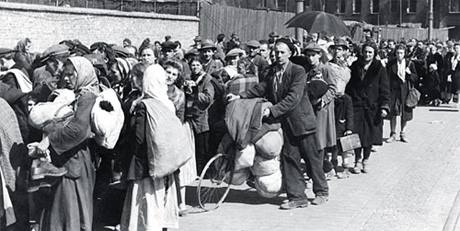
Fleeing war

I was 13 when the army invaded. Those who were around the last time it happened had told us about the atrocities they committed, and we were really scared. So, along with many others, my family and I packed a few belongings and fled.

My mother took our little dog along and he became our air strike warning. He would hear - or feel, I'm not sure - the planes before we did, so whenever he started whining, we took cover, often in ditches. My mother would cover us with a big red blanket. I don't know what kind of protection she thought that was! The noise from the planes was terrifying, the bombs were even more so.

We crossed the border, but we were not welcome. Villages had signs saying there was no water for us. We were exhausted. We had to sleep in ditches.

At one point we met another family who came from the same village as we did. One of the boys, who would become my husband once we grew up, wrote me a card. I still have it. But we lost each other again  that time and only saw each other again when we came back to our village.

I understand those people fleeing war. We did the same thing.

- my grandmother

When the German army invaded Belgium in 1940, 2 millions Belgians, Dutch and Luxemburgers fled and became refugees in France.